Is YouTube Demonetizing AI Videos? What the Policy Says

Summary: Is YouTube demonetizing AI videos? Not for using AI itself. It is demonetizing content that looks mass-produced, repetitive or templated, under a rule renamed "inauthentic content" in July 2025 and clarified in July 2026. In 30 public cases we reviewed, no rejection notice cited AI itself; most cited inauthentic or repetitive content.
Is YouTube demonetizing AI videos?
No, not for using AI as such. YouTube's monetization policies allow AI-assisted videos, and say you can use AI to edit scripts or visualize your own story. What gets channels rejected is content that feels mass-produced: the same template, similar narration and interchangeable videos at volume.
That distinction explains the wave of headlines. Many AI channels were built to publish fast from a template, and that format is exactly what the policy targets. Channels that use AI as a tool inside an original production are judged like any other channel.
What is YouTube's inauthentic content policy?
The inauthentic content policy is the part of YouTube's monetization rules that covers repetitive or mass-produced content. On July 15, 2025, YouTube renamed it from "repetitious content" to "inauthentic content" to better describe what it covers. It applies to the channel as a whole, not one video.
The policy page gives examples of what does not qualify for monetization, including content that only differs superficially from video to video, and AI content made with generic templates that gives the impression of mass production. A separate rule, the reused content policy, covers videos built mostly from other people's material without meaningful commentary or change. That rule did not change in 2025.
What changed in 2025 and 2026?
Two updates matter for AI creators. In July 2025 YouTube renamed its repetitious content rule to inauthentic content, and in July 2026 it clarified which kinds of AI-made and templated content cannot be monetized, spelling out the rules for AI personas that give sensitive advice.
| Date | What changed | Source |
|---|---|---|
| July 15, 2025 | "Repetitious content" renamed "inauthentic content", covering repetitive or mass-produced content | YouTube monetization policies |
| July 2026 | Clarification naming three kinds of content that cannot be monetized: repetitive or templated content made easily with AI or templates, unsatisfying or off-putting content, and AI personas giving advice on sensitive topics such as finance, legal or health | TechCrunch, July 20, 2026 |
The monetization policy page now carries matching sections. If you run a channel that shares advice through an AI presenter, the sensitive-topics rule is the one to read closely.
Why AI channels get demonetized: what 30 public cases show
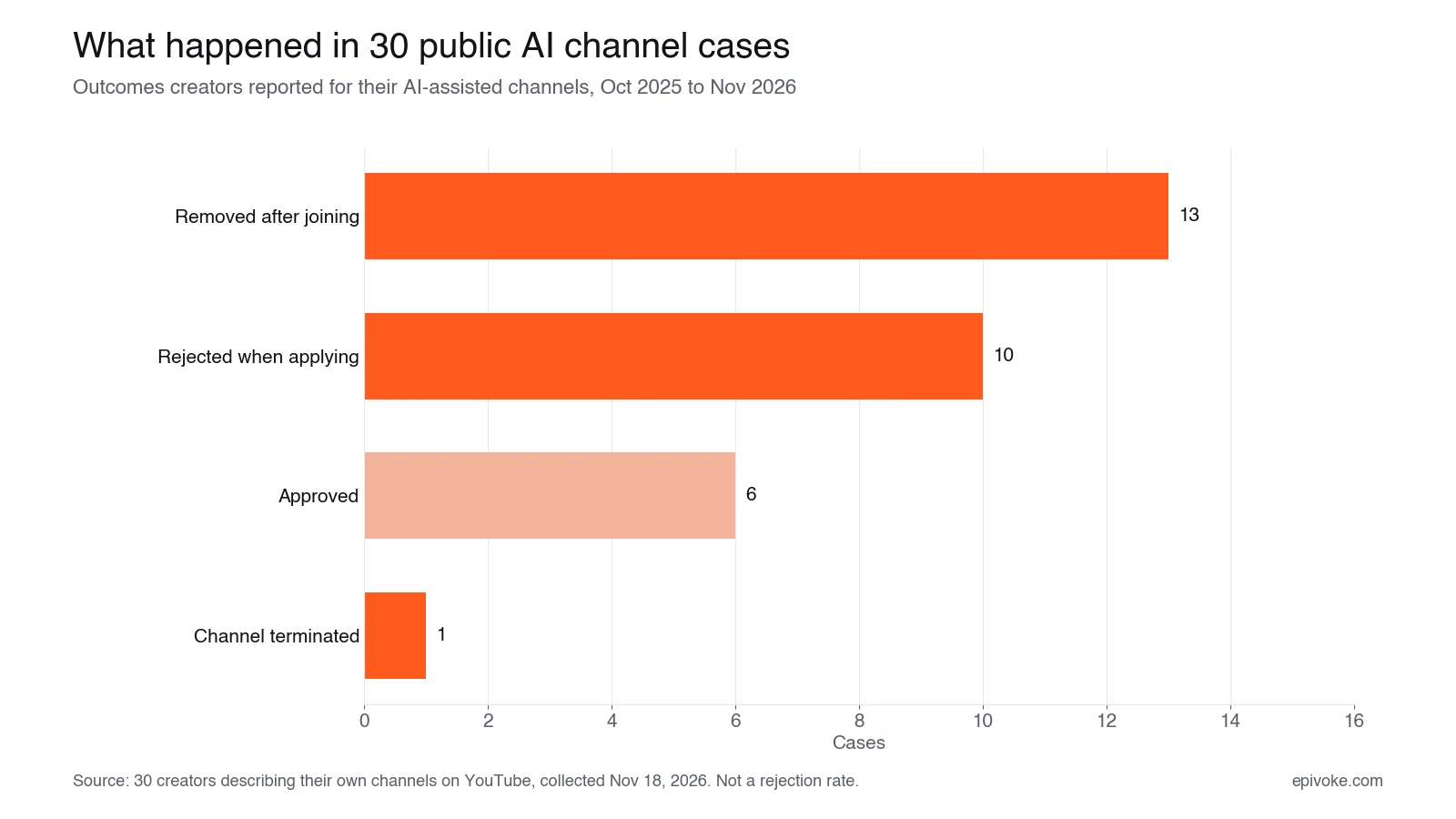
To see how the policy plays out, we reviewed 30 public cases between October 2025 and November 2026 in which creators described, on their own YouTube channels, what happened when their AI-assisted channel applied for or held monetization. We recorded the outcome, the reason YouTube gave as the creator reported it, and the type of content.
| Outcome | Cases |
|---|---|
| Rejected when applying | 10 |
| Removed from the Partner Program after joining | 13 |
| Channel terminated | 1 |
| Approved | 6 |
Five of the 13 removals happened within about a month of being approved, the fastest after three days. Of the 24 negative cases, 7 later regained monetization.
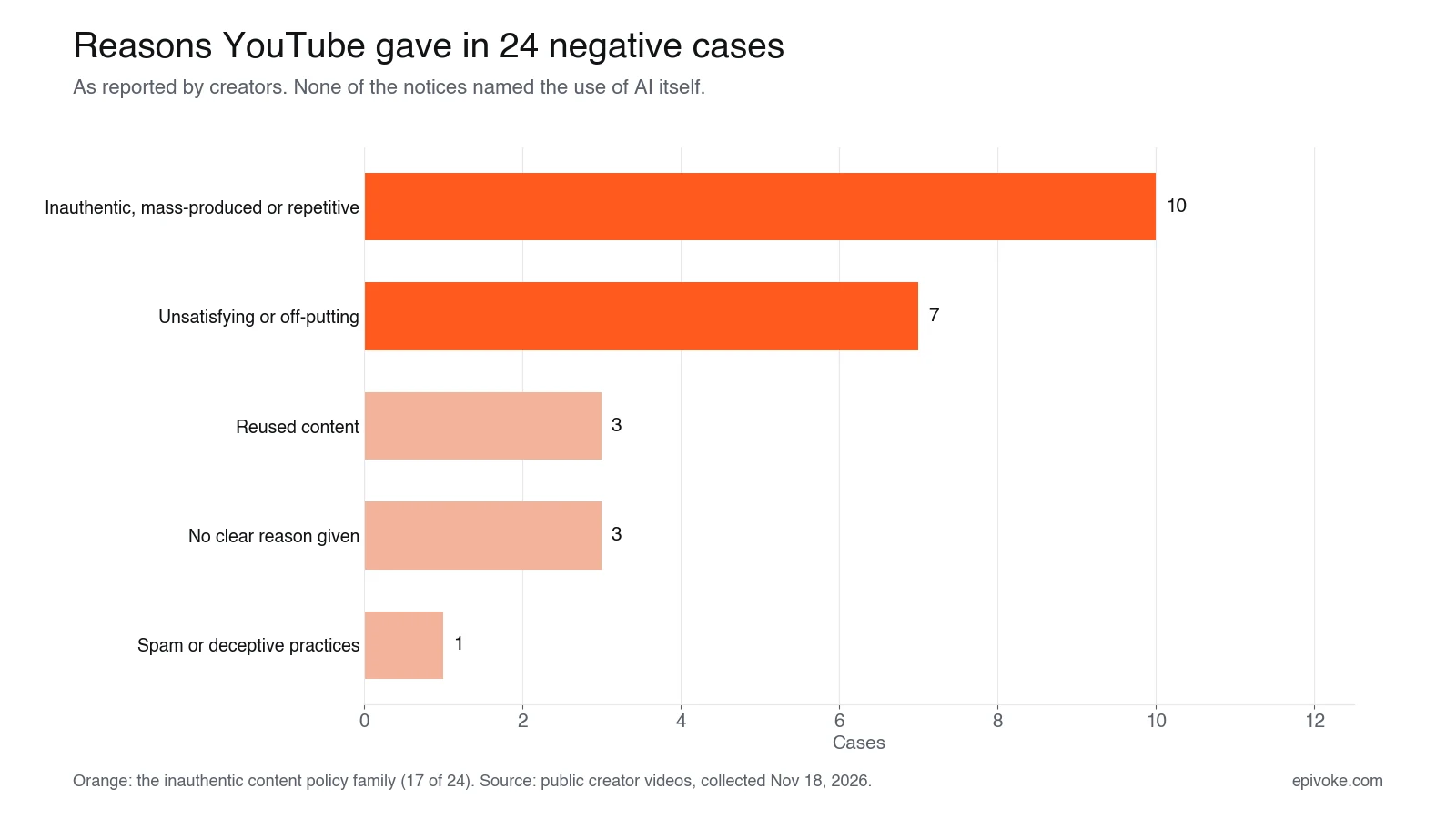
The reasons given. Across the 24 negative cases, the reason most often reported was inauthentic, mass-produced or repetitive content (10 cases), followed by unsatisfying or off-putting content (7) and reused content (3). One cited spam or deceptive practices, and three gave no clear reason. Counting "unsatisfying or off-putting" as part of the inauthentic content family, as YouTube's July 2026 clarification does, 17 of 24 fell under that one policy. None of the notices creators read out or described named the use of AI as the reason.
The content. The most common negative format was AI-generated storytelling or "AI movie" channels (8 cases), then slideshows of AI images with synthetic narration (3). Recurring patterns in what creators described: videos that looked alike, a title formula repeated across the channel, the same stock AI voice used across the niche, and unusually fast growth to the threshold, with one channel qualifying on eight videos and another in under two weeks.
Appeals. Of the 13 appeals with a known result, 4 succeeded and 9 failed. Creators who changed their channel and reapplied after the waiting period recovered about as often as those who won an appeal.
Read these numbers as a picture of patterns, not as a rejection rate. People tend to post when something goes wrong, the sample leans toward short storytelling channels, and several of the creators also sell courses or tools. There is no way to know how many AI channels were approved quietly.
Are faceless channels treated differently?
No. The policy looks at whether content is original and meaningfully varied, not at whether a face appears on screen. Faceless documentary and explainer channels earn through the Partner Program on the same terms as any other channel, as long as each video is clearly its own work.
What faceless AI channels share with the rejected cases above is risk, not a rule: it is easy to fall into one template. Our guide on how to start a faceless YouTube channel covers how to build a channel that avoids that pattern.
What YouTube looks for in AI-assisted videos
YouTube looks for evidence that each video is its own piece of work. Reading the policy alongside the cases, four signals separate original AI-assisted channels from mass-produced ones, and each one is something a reviewer can see on your channel page in a minute:
- An original script for every video. Researched, specific and written for that topic, not a template with names swapped in.
- Facts with sources. Specific claims that can be checked are the opposite of generic filler.
- Visuals that change with the story. Different footage, maps and charts per video, not the same image style on every upload.
- Footage you have the right to use, with a record. Reused clips are their own policy problem; a license record answers that question fast.
The last point is where a license sheet earns its place. Our explainer example video lists 71 visual clips on its sheet, each with its library and license: 61 from a stock library, 6 public domain archive files and 4 from a free media library. Our guide to fair use and licensed footage explains how to read and keep one.
How do you appeal a demonetization decision?
You can appeal a rejected Partner Program decision within 21 days, according to YouTube's Partner Program overview. Reviewers look at the channel as a whole. If the appeal fails, you can reapply after 30 days, or after 90 days if it is not your first rejection, ideally after fixing what was flagged. Before you reapply, confirm you still meet the thresholds with our YouTube monetization checker.
Creators in our sample who won appeals or reapplied successfully described the same fix: they made their channel look less like a production line, with more varied videos, stronger scripts and fewer near-identical uploads.
Do you need to disclose AI on YouTube?
Disclosure is a separate rule from monetization. YouTube's altered or synthetic content rules ask you to label realistic content that AI made or changed, such as a real person appearing to say something they never said, or a realistic scene that never happened.
You do not need to label AI help with scripts or captions, and YouTube says the label by itself does not limit a video's reach or its ability to earn. Labeling honestly does not cause demonetization; mass-produced content does.
Make AI-assisted videos with original scripts and licensed footage
Epivoke makes long-form documentaries from a topic or your own script, kept word for word. When it writes the script, every factual claim comes with a source, and every video ships with the full source list and a license sheet covering each clip. Monetization always depends on YouTube's review of your channel. See the example videos or start one on the long-form AI video generator.
FAQ
Will YouTube demonetize AI content?
Not for being AI-made. YouTube demonetizes content that is mass-produced, repetitive or templated under its inauthentic content policy. AI-assisted videos with original scripts, varied visuals and properly licensed footage can be monetized like any other content.
Is YouTube going to remove AI videos?
No general removal of AI videos has been announced. YouTube removes content that breaks its Community Guidelines, AI or not, and separately limits monetization for mass-produced content. Realistic AI content must carry a disclosure label, but labeled videos can stay up and earn.
Can AI voiceover videos be monetized?
Yes. YouTube's monetization policies do not prohibit AI voiceover. Rejections in public cases came from repetitive channels, often using the same stock voice and template across every video, rather than from the voiceover itself. Pair the voice with an original script and varied visuals.
What does "mass-produced" mean on YouTube?
Mass-produced means content that is made at volume from a template, with only surface differences between videos, such as the same structure and narration style with new names or images. YouTube treats it as inauthentic content, which cannot be monetized.
Does YouTube demonetize whole channels or single videos?
YouTube reviews a channel as a whole for the Partner Program, so inauthentic or reused content decisions usually cover the whole channel. The cases we collected were all channel-level decisions, which is how we selected them.
Is making AI videos on YouTube legal?
Yes. Making and uploading AI-assisted videos is allowed, provided you have the rights to the footage, music and voices you use, label realistic synthetic content, and do not impersonate real people. Monetization is a separate question decided by YouTube's policies.
How do I know if my channel is at risk?
Open your channel page and look at it as a reviewer would. If the thumbnails, titles and video structure look interchangeable, or the channel posts many near-identical videos quickly, it is at risk. Varied, well-researched videos with their own scripts are the safest signal.