50 Faceless YouTube Channel Ideas That Pay (2026)

Summary: The best faceless YouTube channel ideas are niches where you can keep finding licensed footage and tell a story past eight minutes: history, geography and business, science, how things work, top lists, and historical true crime. Below are 50 ideas across those six niches, each with a concrete angle, plus an example video we made for every niche.
What makes a good faceless YouTube niche?
A good faceless niche is one you can feed every week without a camera. That means three things: the topic has footage you are allowed to use, each story is rich enough for an 8 to 20 minute video, and viewers search for it year round rather than for one news cycle.
We picked the 50 ideas below with four tests, in this order:
- Can you keep publishing? If good footage runs out after ten videos, the channel stalls. We favored topics with deep stock and archive libraries behind them.
- Does it fill eight minutes or more? Videos of eight minutes and longer can carry mid-roll ads, so a niche with layered stories earns more per view. Our guide to long-form video on YouTube explains the cutoffs.
- Do advertisers pay for the audience? Ad rates differ a lot by niche. See our YouTube CPM and RPM data by niche for the numbers.
- Is it clearly original? Niches built on other people's clips are the ones YouTube flags. More on that below.
Faceless YouTube channel ideas at a glance
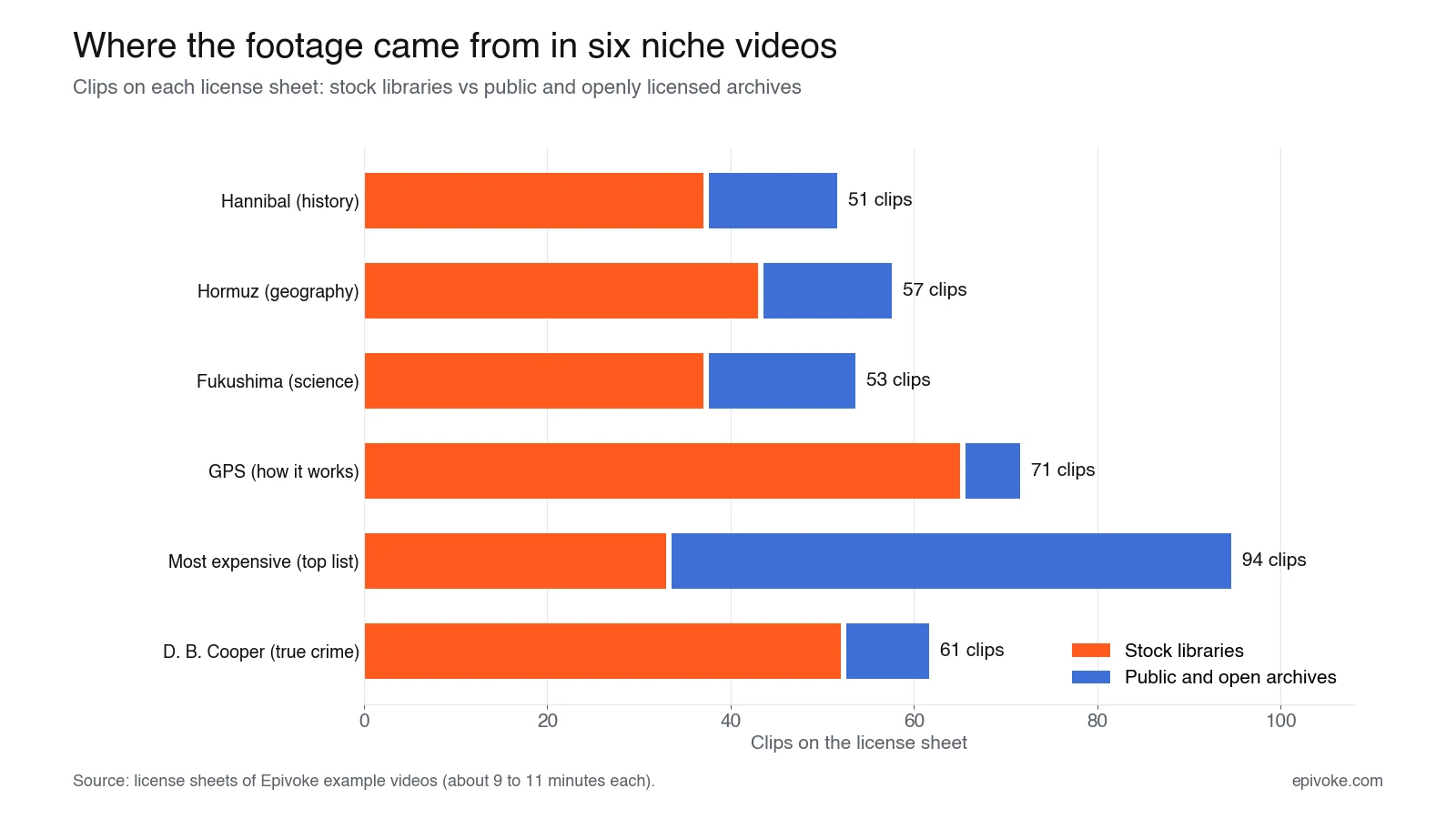
Every niche in this table has a finished example video behind it. We made each one with Epivoke, starting from a single topic prompt, and counted what ended up on its license sheet.
| Niche | Example video | Length | Clips on the license sheet | Where the footage came from |
|---|---|---|---|---|
| History | Hannibal Crossed the Alps. Which Pass Did He Take? | 9:13 | 51 | Stock library, plus 14 Wikimedia Commons files |
| Geography and business | Hormuz Never Really Closed. It Just Got Expensive. | 9:24 | 57 | Stock library, plus 14 Wikimedia Commons files |
| Science and engineering | Fukushima Has 880 Tonnes of Melted Fuel. They've Removed Under a Gram. | 10:12 | 53 | Stock library, plus 15 files from the plant operator's photo library |
| How things work | How Your Phone Finds You When No Satellite Knows Where You Are | 10:29 | 71 | Stock library, plus 6 public archive files |
| Top lists | The 7 Most Expensive Things Ever Built (#1 Is a Road) | 10:18 | 94 | Mostly public domain archives, including 19 NASA files |
| Historical true crime | D. B. Cooper Took 10,000 Bills. Only 290 Ever Came Back. | 10:22 | 61 | Stock library, plus FBI and other public domain files |
Two patterns stand out. A ten-minute documentary uses 50 to 95 separate clips, so a niche needs a deep footage supply. And history, space and crime topics can draw on public domain and openly licensed archives alongside stock footage, which keeps them sustainable for years.
History and historical mysteries
History is the most reliable faceless niche: the stories never run out, and public archives hold millions of maps, paintings and photos.
- Ancient routes and lost armies. Retrace a march, a voyage or a retreat against the real terrain.
- Unsolved historical mysteries. Lay out the evidence for each theory, then let viewers judge.
- One day, minute by minute. Rebuild a famous day from the records, such as a coronation or an evacuation.
- How empires fell. One empire per video, told through the three or four decisions that sealed it.
- The history of everyday objects. Forks, zippers, shipping containers and the stories behind them.
- Shipwrecks and lost expeditions. What went wrong, and what divers or historians found later.
- Forgotten inventors. People who built something world-changing and got no credit.
- Cold War close calls. Incidents that nearly went very wrong, told from declassified records.
- Ancient engineering. How aqueducts, pyramids and roads were built with the tools of the time.
- Myth versus record. Famous legends checked against what the sources actually say.
Geography, business and money
These niches tend to attract well-paying advertisers, because the audience skews toward adults interested in money, trade and companies.
- Chokepoints and trade routes. Why one strait or canal moves a big share of the world's goods.
- Why borders look the way they do. Strange lines on the map and the treaties behind them.
- How companies collapsed. Bankruptcies and buyouts traced back to a few choices. Our Getty Images video is an example.
- Follow one product. Trace a phone, a banana or a barrel of oil from source to shelf.
- Megaprojects that went over budget. Railways, airports and cities that cost far more than planned.
- A country's economy, explained. What one nation earns from, and what it imports.
- Brand origin stories. How a household name started and nearly failed.
- Ghost cities and abandoned places. Why people left, and what remains.
- How an industry makes money. Airlines, streaming or supermarkets, followed dollar by dollar.
- Resource stories. Lithium, water, helium or sand, and who controls the supply.
Science, engineering and how things work
Explainer niches reward clear structure. Viewers come for the "how", so animated maps, diagrams and charts carry a lot of the story.
- Disasters, explained. What happened inside a reactor, a dam or a bridge, step by step.
- How everyday technology works. GPS, Wi-Fi, credit card payments, touchscreens.
- Space missions. One mission per video: the goal, the risk, the result.
- Engineering failures. Structures that broke, and the lessons that changed building codes.
- The physics of extremes. The coldest, hottest or fastest things ever measured.
- Medical breakthroughs in history. How a treatment was discovered and tested.
- Future tech, reality-checked. Where a hyped technology really stands today.
- Extreme weather, explained. How a hurricane, heat dome or flood forms.
- Hidden infrastructure. Power grids, sewers and undersea cables.
- How things are made at scale. Chips, glass, steel or paper from raw material to product.
- The deep sea and other extreme habitats. What lives there and how scientists study it.
- Stories from mathematics. Famous problems, codes and the people who cracked them.
Top lists and historical true crime
Ranked lists give viewers a reason to stay until number one. Historical true crime gives them a mystery to solve. Both work well past ten minutes.
- The most expensive things ever built, ranked in today's money.
- The largest, deepest or fastest structures, machines or animals.
- The biggest business mistakes and what each one cost.
- Cities or countries ranked by data, such as rainfall, debt or commute time.
- The greatest heists in history, ranked by haul.
- The strangest laws still on the books, and why they were written.
- Abandoned megastructures, ranked by size or cost.
- Inventions ranked by impact on how people live.
- Record-breaking journeys, from first flights to polar crossings.
- Decades-old unsolved cases. Lay out the timeline and the evidence, then each theory.
- Famous cons and swindles, told from the court records.
- Art forgeries and how experts finally caught them.
- Cold War spy cases from declassified files.
- Historic trials that changed the law.
- Daring prison escapes from history.
- Smuggling routes of the past, from rum running to art theft.
- Disappearances at sea and in the air that investigators still debate.
- Financial frauds that fooled regulators for years.
For true crime, stick to historical cases with public records. Avoid private people who are still alive, and treat victims with care.
Which faceless niches get flagged by YouTube?
YouTube does not penalize a channel for being faceless. Its monetization policies target content that is repetitive or mass-produced, and since July 15, 2025 that rule has been called inauthentic content.
The same page says AI content built from generic templates that gives the impression of mass production cannot be monetized. A separate reused content rule covers videos made mostly of other people's material. Niches built on reaction clips, compilations or one template with new words are the ones most at risk.
Original niches stay safe for the same reason they keep viewers: every video has its own script, its own structure and its own footage. Read why some AI channels get demonetized for real cases.
How do you pick the right niche for you?
Pick the niche where your curiosity, the ad rates and the footage supply overlap. Write down ten video titles you would genuinely want to watch. If you can list ten quickly and footage exists for each, you have a niche that can last.
Then estimate what it could earn: multiply your expected monthly views by a niche RPM from our RPM data by niche, then divide by 1,000, or run the numbers in our YouTube money calculator. Finally, make three videos before judging the niche. One video tells you very little; three show you how the topic feels to produce every week.
Turn a niche idea into a finished video
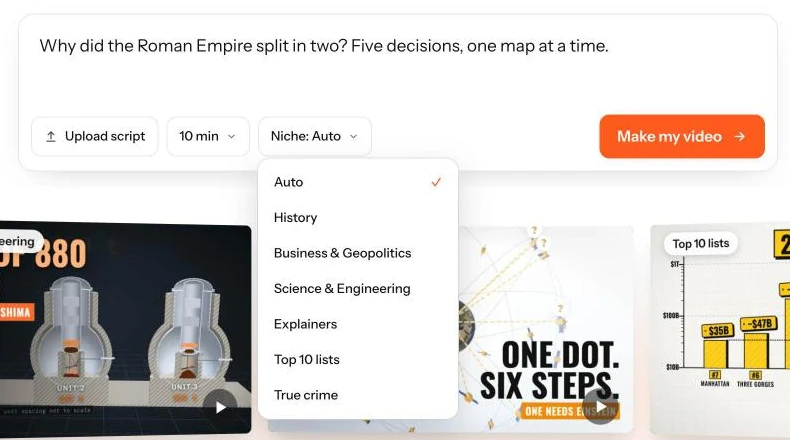
Epivoke makes finished faceless documentaries from a one-line topic or your own script: research, script, voiceover, licensed footage, animation, captions and music in one 1080p MP4, from 8 to 60 minutes. Every video ships with a license sheet listing each clip and its license. Watch the example videos above, or see how it works on our AI explainer video generator page.
FAQ
What is the best content for a faceless YouTube channel?
The best faceless content is documentary-style storytelling: history, science explainers, business stories, top lists and historical true crime. These niches have deep footage libraries, support videos longer than eight minutes, and attract advertisers, so they can grow and earn at the same time.
How many views do you need to make $10,000 a month on YouTube?
It depends on your RPM, the amount you earn per 1,000 views. At $6.43, the median RPM in our sample of 20 creators, you need about 1.6 million long-form views a month. At a $12 RPM, about 830,000. Divide your target by your RPM, then multiply by 1,000.
What is the most profitable faceless YouTube niche?
Finance and business topics tend to pay well, because advertisers bid more to reach viewers who are about to spend money. In our own sample of creator reports, a business tutorial channel earned $11.95 per 1,000 views against a $6.43 median, though audience country mattered as much as topic. Pick a high-paying niche you can sustain.
Can you start a faceless channel with no money?
Yes. A YouTube channel is free, and you can write scripts, record your own voice and use free public domain footage. The trade-off is time: a hand-made ten-minute documentary can take days. Paid tools mainly buy back that time.
Are AI-made faceless videos allowed to monetize?
Yes, if they are original. YouTube's rules target mass-produced and repetitive content, not the use of AI. Videos with their own script, varied visuals and properly licensed footage can join the YouTube Partner Program like any other channel.
How long should faceless videos be?
Aim for 8 to 20 minutes for most documentary niches. Eight minutes unlocks mid-roll ads, and longer stories keep viewers in a session. Go longer when the story genuinely needs it, such as deep history or a complex case.
How often should a faceless channel post?
Post on a schedule you can keep for months, such as one or two long videos a week. Consistency matters more than volume, and a steady rhythm of strong videos beats a burst of rushed ones that viewers skip.