Fair Use on YouTube: What Footage You Can Actually Use
Summary: Fair use on YouTube is a defense in US copyright law, not a permission you get in advance. It does not stop Content ID from claiming your video automatically. For monetized videos, the dependable approach is licensed footage: stock libraries, public domain archives and openly licensed files, with a record of where every clip came from.
This article is general information, not legal advice.
What is fair use on YouTube?
Fair use is a part of US copyright law that lets you use copyrighted material without permission in some situations, such as commentary, criticism, news reporting, teaching or parody. On YouTube it is decided case by case, and only a court can make the final call.
YouTube's own fair use help page describes it the same way and is clear that there are no magic words or checklists that make a use fair. Other countries have narrower rules, such as fair dealing in the UK and Canada.
The four factors that decide fair use
Courts weigh four factors, set out in Section 107 of the US Copyright Act. No single factor decides the outcome, and the US Copyright Office's Fair Use Index collects real court decisions if you want to see how they play out.
| Factor | The question it asks | What tends to help |
|---|---|---|
| Purpose and character of the use | Are you transforming the work, or just reusing it? | Commentary, criticism or analysis that adds new meaning |
| Nature of the copyrighted work | Is the original factual or highly creative? | Using factual material such as news footage |
| Amount used | How much of the original did you take? | Using the smallest part needed for your point |
| Effect on the market | Could your video replace the original for viewers? | A use that does not substitute for buying or watching it |
For online video, the first factor is where most debates start. A history documentary that pauses on an archive clip to analyze it is in a very different position from a channel that reposts the same clip with music over it.
Does fair use protect you from Content ID claims?
No, not automatically. Content ID is an automated system that matches uploads against files submitted by rights holders and applies their chosen action, such as blocking the video or taking its ad revenue. It does not assess fair use when it matches.
If you believe your use is fair, you can dispute the claim in YouTube Studio and explain why. The rights holder then reviews it and can release the claim, uphold it, or escalate to a formal copyright removal request. Fair use is something you argue after a claim, not a shield that prevents one.
What happens if you get a copyright claim or strike?
A Content ID claim and a copyright strike are different things. A claim usually means the rights holder takes the ad revenue or limits where the video plays. A strike follows a formal legal removal request and counts against your channel.
Under YouTube's copyright strike rules, three strikes within 90 days make a channel subject to termination. A strike expires after 90 days, provided you complete YouTube's Copyright School and do not collect further strikes. A Content ID claim, by contrast, typically does not lead to a strike. This is why channels that rely on other people's footage carry real risk, even when many of their uses could be fair. Reused footage is also one of the patterns behind AI channel demonetizations.
Is "copyright free" footage really free to use?
It depends on the exact license. "Copyright free" usually means one of three things: the work is in the public domain, it is under an open license with conditions, or it is royalty free stock that still requires a license. Each one has different rules.
Creative Commons Attribution (CC BY) files allow commercial use but require you to credit the creator, link the license and note any changes. Share-alike (CC BY-SA) adds that adaptations must carry the same license. Public domain works, such as most US federal government photos, can be used freely. Royalty free stock clips need an active license from the library. Read the license on every file and save it.
Does a fair use disclaimer protect you?
No. Writing "no infringement intended" or pasting a fair use notice into your description does not make a use fair, and it does not stop Content ID.
YouTube's fair use page says plainly that there are no magic words, and that giving credit does not by itself turn a copy into fair use. What counts is how you use the material, judged by the four factors.
Giving credit is good practice and is required for some licenses, but credit alone is not permission. If you did not license a clip and your use is not clearly transformative, the disclaimer changes nothing.
Where to find licensed footage for YouTube videos
The safest footage for monetized videos is footage with a clear license you can show on request. These are the main sources documentary creators use.
| Source type | Examples | License basics | Credit needed? |
|---|---|---|---|
| Paid stock libraries | Storyblocks and similar subscriptions | Licensed for use in your videos while you follow the library's terms | Usually no |
| Free stock libraries | Pixabay, Pexels | The library's own content license | Usually no, but check |
| Public domain archives | US government sources such as NASA, the National Archives, the FBI | Most US federal works are public domain | Courtesy credit recommended |
| Openly licensed collections | Wikimedia Commons | Each file has its own license, often CC BY or CC BY-SA | Often yes |
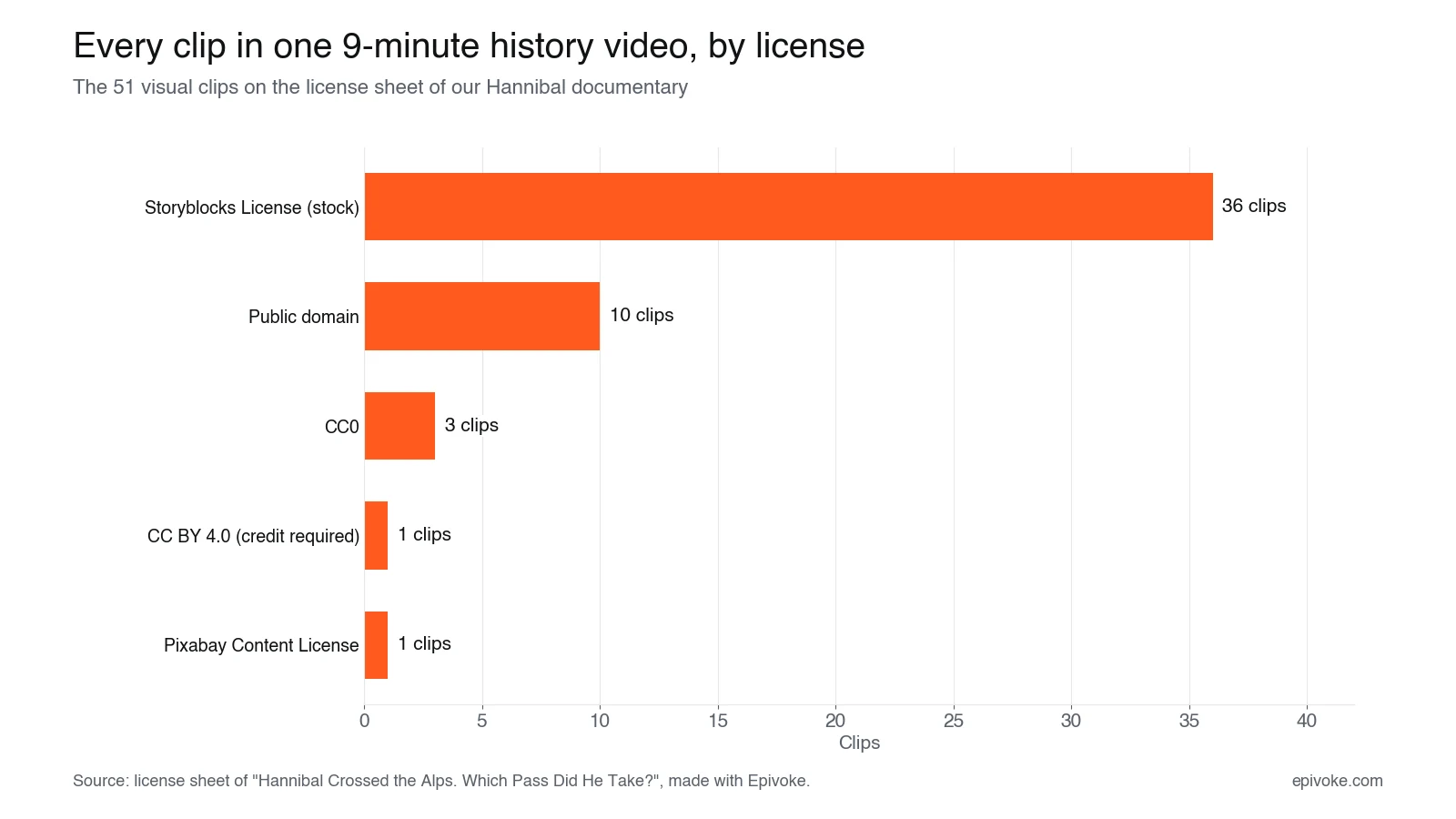
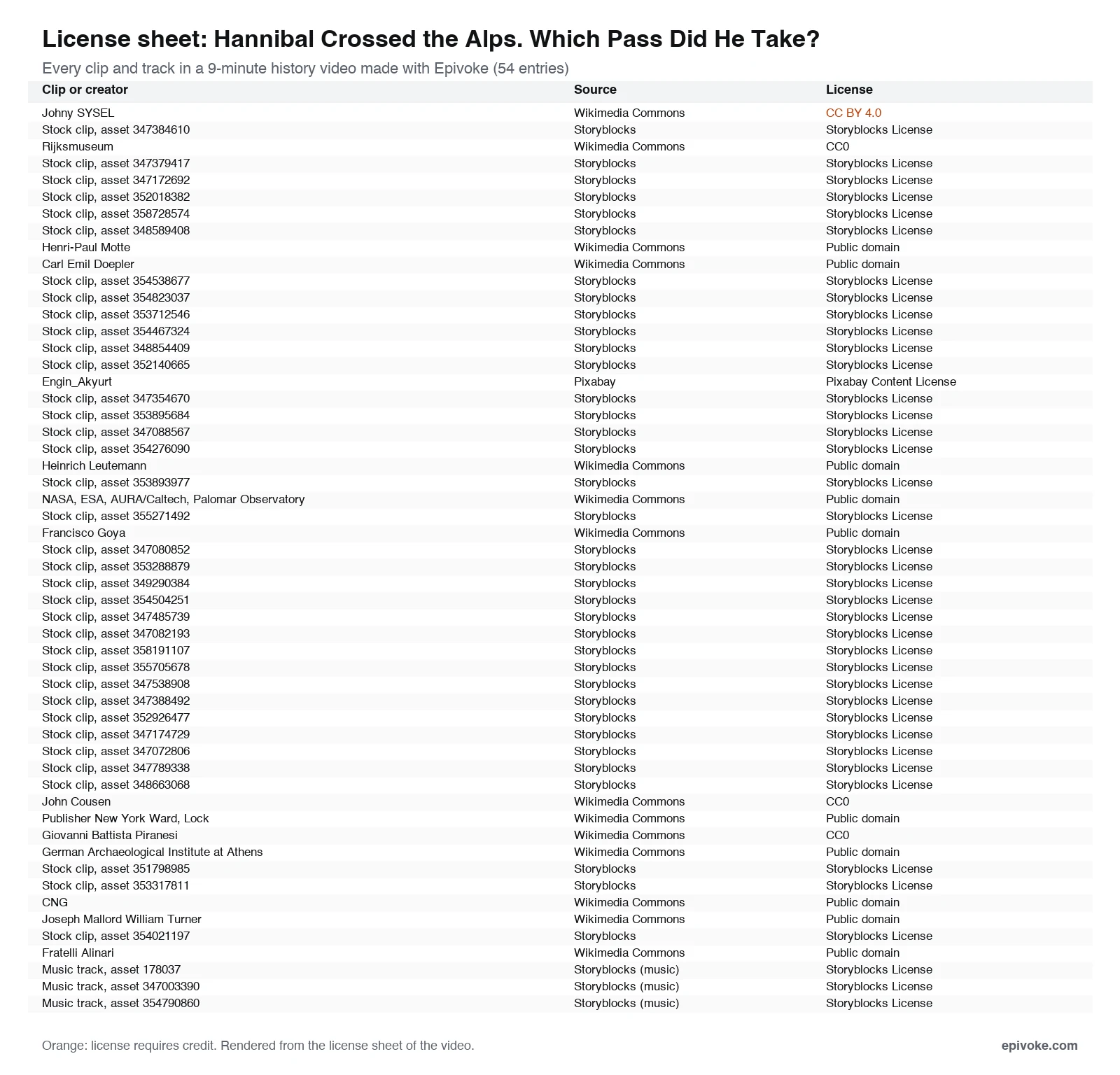
Mixing these sources is normal. Our history example video uses 36 clips from a paid stock library, 14 files from Wikimedia Commons and one free stock clip.
What a license sheet looks like
A license sheet is a list of every clip in a video with its source and license. It is the fastest way to answer a claim, prove your rights to a sponsor, or check attribution before you publish. Here are real lines from the license sheet of our Hannibal video:
| Clip | Source | License |
|---|---|---|
| Painting of Hannibal crossing the Rhône, Henri-Paul Motte, 1878 | Wikimedia Commons | Public domain |
| Hannibal Crossing the Alps, John Cousen, Yale Center for British Art | Wikimedia Commons | CC0 |
| Roman Republic coin, photo by Johny Sysel | Wikimedia Commons | CC BY 4.0 (credit required) |
| Snow Storm, J. M. W. Turner | Wikimedia Commons | Public domain |
| Stock video clip, asset ID 347384610 | Storyblocks | Storyblocks License |
| Stock video clip by Engin Akyurt | Pixabay | Pixabay Content License |
| Music track, asset ID 347003390 | Storyblocks | Storyblocks License |
Every Epivoke video ships with a sheet like this, covering all clips and music. If you switch on the optional Full web mode, any clip taken from the open web is marked WEB on the sheet so you can review it before publishing.
How to keep your channel safe
Keeping a channel safe from claims comes down to records and habits. Save proof of every license, credit what the license asks for, and avoid the footage rights holders police most. These five habits cover most situations new channels run into, and our YouTube monetization checker covers the eligibility side.
- Save the license for every clip at the moment you download it.
- Put required credits in the description, in the format the license asks for.
- Avoid full scenes from films, TV and music videos. These are the most actively claimed.
- Transform what you borrow. If you do rely on fair use, analyze or comment on the clip rather than replaying it.
- When a claim arrives, check your sheet first. If the clip is licensed, dispute with the license details.
Get licensed footage and a license sheet with every video
Epivoke is a long-form AI video generator that builds documentaries from licensed stock libraries and openly licensed archives, and lists every clip with its library and license type on the sheet that ships with the video. See the clips used in our example videos and read our content policy for what you can make. New to the format? Start with how to start a faceless YouTube channel.
FAQ
How many seconds of a video can I use under fair use?
There is no set number of seconds. The US Copyright Office says no formula fixes how much of a work you can use without permission. A short clip can still infringe, and a longer one can be fair if the use is transformative.
Is it legal to use YouTube videos under fair use?
It can be, if your use is transformative, such as commentary, criticism or analysis, and meets the four factors. It is decided case by case. Reposting someone's video with little change is very unlikely to qualify and can lead to claims or strikes.
Do I need permission to use a YouTube video?
In most cases, yes. Unless the video is in the public domain, under an open license that allows reuse, or your use clearly qualifies as fair use, you need the owner's permission. Asking the creator directly and keeping their written reply is the safest route.
Is it fair use if I give credit?
No. Credit alone does not make a use fair. Fair use depends on how and why you use the material. Credit is still important, and licenses such as CC BY require it, but it is not a substitute for permission or a fair use basis.
Are Wikimedia Commons videos free for YouTube?
Many are. Wikimedia Commons does not accept licenses that forbid commercial use, but each file has its own license. Public domain and CC0 files can be used freely; CC BY needs a credit and CC BY-SA adds share-alike terms. Record each file's license before use.
Can I monetize a video that uses fair use clips?
Yes, monetization does not rule out fair use. But a fair use clip can still trigger a Content ID claim that redirects revenue until you dispute it. With licensed footage and a license record, that dispute is usually quick to resolve.
What should I do if I get a Content ID claim?
First check where the clip came from. If you licensed it, dispute the claim in YouTube Studio with the license details. If you believe your use is fair, explain why in the dispute. If neither applies, replace or trim the clip.