Average YouTube CPM and RPM by Niche (2026 Data)

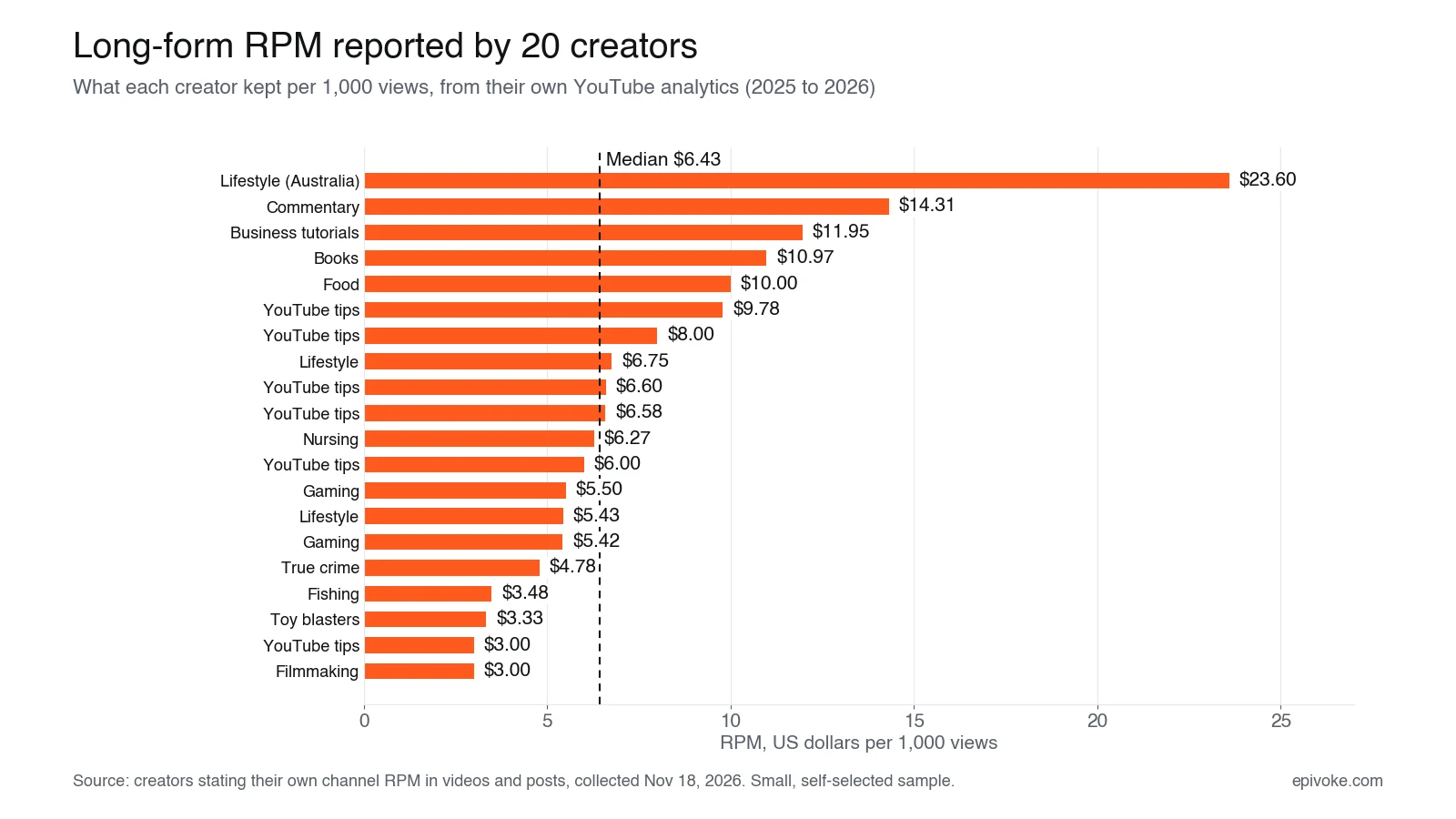
Summary: The median YouTube RPM, what creators actually keep per 1,000 views, was $6.43 across 20 creators who shared their own analytics in 2025 and 2026; the middle half earned $5.26 to $9.83. Average YouTube CPM, what advertisers pay, ran higher, about $8 to $29 for the four who reported it. Shorts earned about $0.19.
What is the average YouTube CPM in 2026?
In our sample, the four creators who shared their CPM reported about $8 to $29 per 1,000 ad impressions, and the median RPM across all 20, what they kept per 1,000 views, was $6.43. The figures come from creators showing their own YouTube analytics in 2025 and 2026.
CPM and RPM measure different things, and most confusion about YouTube pay comes from mixing them up. The next section explains the difference before we get to the numbers.
CPM vs RPM: what is the difference?
CPM is what advertisers pay; RPM is what you earn. YouTube defines CPM as the cost an advertiser pays per 1,000 ad impressions, and RPM as your revenue per 1,000 views after YouTube's share.
RPM is usually lower than CPM, because not every view shows an ad and YouTube keeps part of the revenue. It can come close when memberships or Super Chats add to it.
| Metric | What it measures | Who it is about |
|---|---|---|
| CPM | Cost per 1,000 ad impressions | The advertiser |
| Playback-based CPM | Cost per 1,000 playbacks where an ad was shown | The advertiser |
| RPM | Revenue per 1,000 views, after YouTube's share, across all revenue sources | You |
On long-form videos, creators in the YouTube Partner Program receive 55% of net ad revenue (YouTube Help). Shorts work differently: ad revenue goes into a Shorts Creator Pool, and creators keep 45% of the share allocated to them. That is why RPM is the number to use when you estimate income.
YouTube RPM by niche: what creators report
To get real numbers rather than estimates, we collected RPM figures that creators stated about their own channels on November 18, 2026. Most came from creators reading out their YouTube Studio analytics in income videos published in 2025 and 2026, plus a few from published interviews and newsletters. We kept figures that cover a channel or a period rather than a single video, and left out non-USD figures. Where a creator read out monthly figures without an average, we used the median of those months.
| Niche | Creators | Long-form RPM reported |
|---|---|---|
| Make money online and YouTube tips | 6 | Median $6.59 (range $3.00 to $9.78) |
| Lifestyle and vlog | 3 | Median $6.75 (range $5.43 to $23.60) |
| Other niches: books, fishing, filmmaking, nursing, toy blasters | 5 | Median $3.48 (range $3.00 to $10.97) |
| Gaming | 2 | $5.42 and $5.50 |
| Entertainment and commentary | 1 | $14.31 |
| Business tutorials | 1 | $11.95 |
| Food | 1 | About $10 |
| True crime | 1 | $4.78 |
| All 20 creators | 20 | Median $6.43 (middle half $5.26 to $9.83) |
Most creators landed between $5 and $10, whatever their niche. The outliers explain themselves: the top figure, $23.60, came from a lifestyle channel whose audience is mostly in Australia, and the $14.31 commentary channel counts memberships and Super Chats in its RPM. Treat this as a small, self-selected sample. Creators who publish income videos tend to run smaller channels, often in their first year of monetization, and documentary, science and finance creators rarely say their RPM aloud.
Which niches have the highest YouTube CPM?
Finance, business, technology and education usually have the highest CPMs, because advertisers pay more to reach viewers who are about to spend money. In our own sample, the highest RPM came from an Australia-heavy lifestyle channel ($23.60), followed by a commentary channel ($14.31), a business tutorial channel ($11.95) and a books channel ($10.97). Audience location mattered as much as topic.
High-paying niches share a pattern: viewers who are about to spend money. Our business documentary example is the kind of topic that sits in that bracket, and our list of faceless channel ideas marks which niches lean that way. Finance, software, business and education audiences attract advertisers selling products with high customer value, so those ad slots cost more.
Why does YouTube CPM change by country and by month?
CPM changes because ad prices are set by an auction. When more advertisers compete for the same viewers, prices rise. Advertisers generally pay more to reach audiences in high-income countries, and many creators see prices climb in the fourth quarter as holiday budgets peak, then dip in January.
One creator in our sample, earning a $3 RPM, put it down to a large share of viewers in lower-paying countries, naming India, Pakistan and Morocco, while the $23.60 lifestyle channel's audience is mostly Australian.
Does video length affect YouTube earnings?
Yes. Videos of eight minutes or longer can carry mid-roll ads, so one viewer can see more than one ad. Longer videos also build more watch time per viewer. A 10-minute video does not earn double a 5-minute one by default, but it has more ad positions to fill.
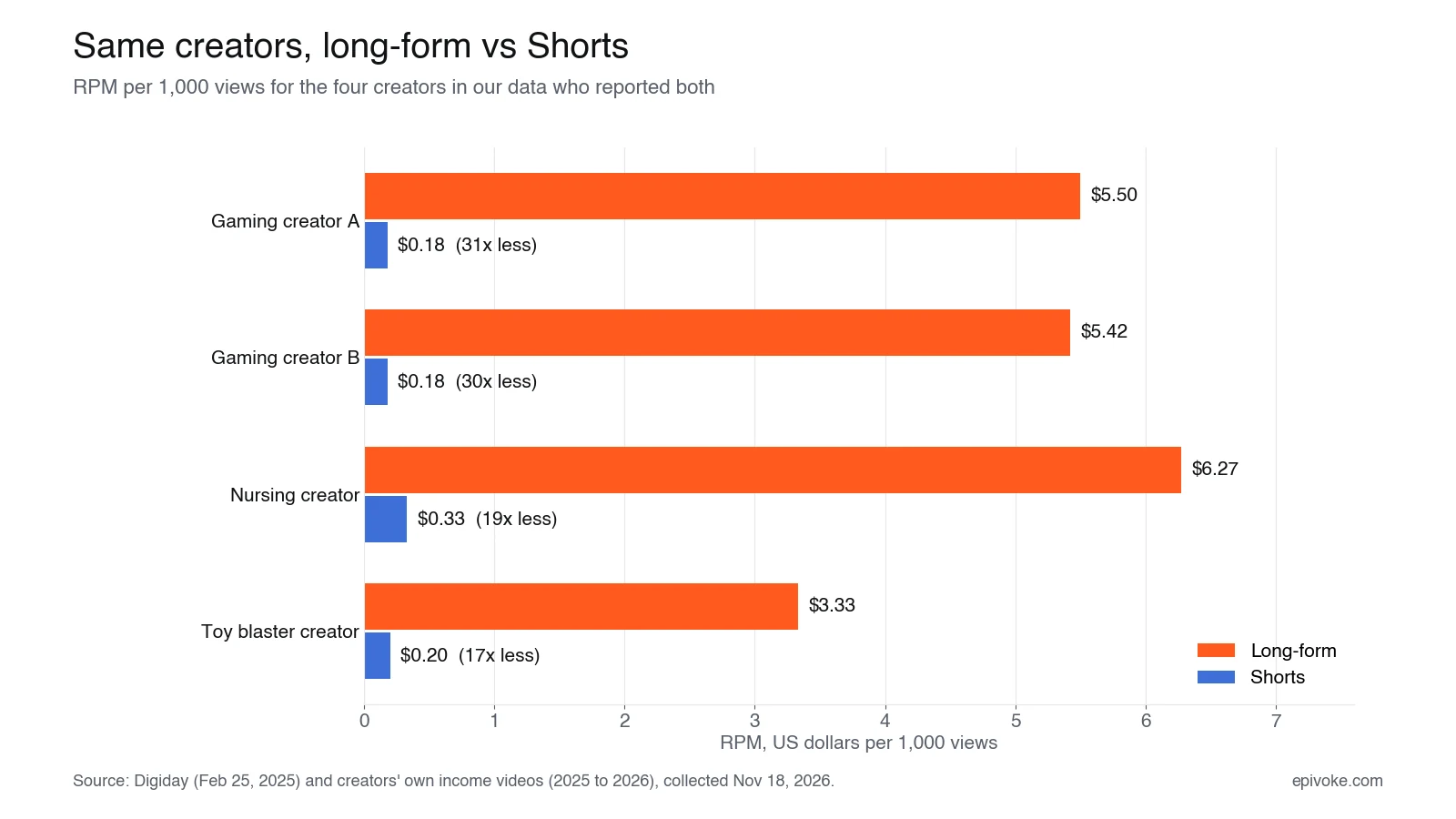
The clearest evidence is the same creator's long-form and Shorts numbers side by side. Four creators in our data reported both, and their long-form RPM was roughly 17 to 31 times their Shorts RPM: $5.50 against $0.18, for example. Our guide to long-form video on YouTube covers where the length cutoffs come from.
How to estimate your own YouTube earnings
The formula is simple: earnings = views ÷ 1,000 × RPM. A video with 100,000 views at a $5 RPM earns about $500. At a $12 RPM, the same views earn about $1,200. The RPM you use matters more than any other input.
At our sample's median RPM of $6.43, a channel needs about 156,000 monthly views to earn $1,000. At $11.95, the business tutorial channel's rate, it needs about 84,000. Run the same math with your own views and niche in our YouTube money calculator.
How to raise your RPM
You raise RPM by changing who watches and how long they stay, not by uploading more. The six levers below come up again and again in the creator reports we collected, and each one is in your control from the next video onward.
- Choose a niche advertisers pay for. Finance, business, technology and education draw higher bids.
- Make videos of eight minutes or more when the story supports it, so mid-rolls are available.
- Write for an English-speaking audience in high-CPM countries if your topic allows it.
- Keep viewers watching. Mid-rolls earn when viewers reach them, so strong structure pays twice.
- Stay original. Channels that look mass-produced can lose monetization entirely; see why AI channels get demonetized.
- Publish steadily through the fourth quarter, when ad prices are highest.
Make longer videos in high-RPM niches
Epivoke makes finished long-form YouTube documentaries from 8 to 60 minutes, so every video can carry mid-roll ads. Type a topic in history, business, science or tech, or paste your own script, and get one 1080p MP4 with voiceover, licensed footage, animated charts, captions and music. Start on the long-form AI video generator, read how to start a faceless YouTube channel, or browse faceless channel ideas by niche.
FAQ
How much does YouTube pay per 1,000 views?
In our sample of 20 creators in 2025 and 2026, YouTube paid a median of $6.43 per 1,000 long-form views, with most between $5 and $10. Shorts paid far less, about $0.19 per 1,000 views.
What is a good CPM for YouTube?
The four creators in our sample who shared CPM reported about $8 to $29, so there is no single benchmark. CPM depends heavily on niche and audience country, and a good CPM is one that rises as your audience and topics become more valuable to advertisers.
Is a $20 CPM high?
It is on the strong side. The four creators in our sample who shared CPM reported about $8 to $29, and two were above $20. A CPM that high usually reflects an advertiser-friendly topic and an audience in high-income countries.
How many views do you need to make $2,000 a month?
At our sample's median RPM of $6.43, you need about 311,000 long-form views a month to earn $2,000. At a $10 RPM, about 200,000. Divide your target by your RPM and multiply by 1,000.
What is a good RPM on YouTube?
Based on our sample, an RPM above $6.43 beats the median creator, and above $9.83 puts you in the top quarter. Long-form channels in business, finance and education aim for $10 or more.
Why is my RPM lower than my CPM?
RPM counts every view, including views where no ad played, and it is measured after YouTube's share of revenue. CPM counts ad impressions and shows what the advertiser paid. So RPM is usually lower, often less than half of CPM.
Do Shorts have the same RPM as long videos?
No. Shorts earn from a shared Shorts Creator Pool rather than ads on each video, and creators keep 45% of their allocated share. Shorts creators in our sample earned a median of $0.19 per 1,000 views. From February 1, 2027, earning from the pool needs 10 million Shorts views in 90 days. Long videos usually earn many times more.
Which country has the highest YouTube CPM?
Advertisers generally pay most to reach viewers in high-income countries such as the United States, so audience location strongly shapes your RPM. In our sample, the highest RPM came from a channel whose audience is mostly in Australia.